

If you own a home or business in South Wales, understanding flat and pitched roof building regulations in the UK is essential before you touch your roof. UK rules sit under Part L of the Building Regulations, which focuses on conserving fuel and power and keeping properties energy efficient. In Wales, these rules are applied through the specific Building Regulations Wales guidance, so properties in Pontypridd, Cardiff, and the Valleys must meet Welsh standards rather than generic UK assumptions.
Whenever you install a new roof or renovate more than around 25% of the existing roof area, building control usually expects you to upgrade the insulation to current standards. This rule often surprises owners who think a “like‑for‑like” replacement will avoid extra costs, but in reality, major roof works trigger modern thermal requirements. For many South Wales homes with older flat roofs or tired pitched coverings, that means thicker insulation, better detailing, and paperwork to prove compliance.
Because South Wales sees frequent heavy rain and strong winds, flat and pitched roofs in areas like Pontypridd, Caerphilly, and Llantrisant work much harder than in drier regions. Persistent moisture, driving rain, and storm events increase the risk of leaks, ponding on flat roofs, and tile or slate failures on pitched roofs. That is why choosing the right warm roof build‑up, checking U‑values, and following ventilation rules is not just a box‑ticking exercise; it directly affects how long your roof lasts.
As you start planning any roof repairs or replacements, you will also want to think about insurance. Many insurers now ask whether your roof meets current standards, especially if you have a large flat roof or an older covering. If the work is not compliant, you could face awkward questions when you make a claim after a storm or serious leak.
PRBG, based in Pontypridd, helps homeowners and commercial clients across South Wales stay on the right side of roof regulations while keeping projects practical and affordable. Our local roofing team understands how Part L, Welsh building control expectations, and real‑world South Wales weather all come together on your roof. Whether you need targeted roof repairs, a full flat roof replacement, or emergency roof leak repair after a storm, we make sure the solution is compliant, energy efficient, and ready to satisfy insurers.
Key Differences Between Flat Roofs and Pitched Roofs in South Wales
When you plan roof repairs or a new installation in South Wales, it helps to understand how flat roofs and pitched roofs are treated differently under building regulations. Both must meet energy‑efficiency targets, but the designs, risk areas, and detailing vary a lot between the two. PRBG works with both styles every day across Pontypridd and nearby areas, so we design practical solutions that work with the regulations rather than against them.
Flat roofs in the UK are often built as warm deck systems, which means the main insulation layer sits above the structural deck so the entire build‑up stays warm. Current guidance typically aims for a roof U‑value around 0.18 W/m²K, so that usually means a relatively thick layer of high‑performance insulation on top. In rainy towns like Pontypridd, common flat roof issues include ponding water, membrane blistering, and premature failure where detailing is poor around edges and penetrations.
Pitched roofs can be designed as either warm roof systems, where insulation follows the slope of the rafters, or cold roof systems, where insulation sits at ceiling level and the loft space stays ventilated and cold. Steeper pitched roofs, typically above about 10 degrees, need effective ridge or high‑level ventilation to control condensation in the roof void and protect the structure. For energy performance, guidance usually targets U‑values in the 0.13 to 0.16 W/m²K range, which often translates into thick quilt insulation or rigid boards, especially in older South Wales properties.
A key local factor many homeowners miss is how Welsh building control treats re‑roofing. If you renew more than a quarter of the roof covering, even on a like‑for‑like basis, you can still be required to upgrade the insulation to meet current standards. This applies to both flat and pitched roofs, so a simple “new tiles” or “fresh felt” project in Pontypridd can quickly become a thermal upgrade project as well.
PRBG helps you navigate these rules from the start, so you know in advance whether your flat roof repair, pitched roof replacement, or mixed roof project is likely to trigger an insulation upgrade. We liaise with local building control where needed and design roof build‑ups that balance compliance, cost, and performance for South Wales conditions. If you want clear advice before you commit to any work, our Pontypridd roofing team is only a quick call away.
Warm Roof Designs Explained
A warm roof is a roof build‑up where the main insulation layer sits above the structural deck or rafters, so the entire structure stays on the warm side of the insulation. This layout reduces cold bridging through joists and beams, improves energy performance, and keeps internal temperatures more stable throughout the year. Because there is no cold void immediately above the ceiling, condensation risks are lower when the warm roof is detailed correctly with proper vapour control.
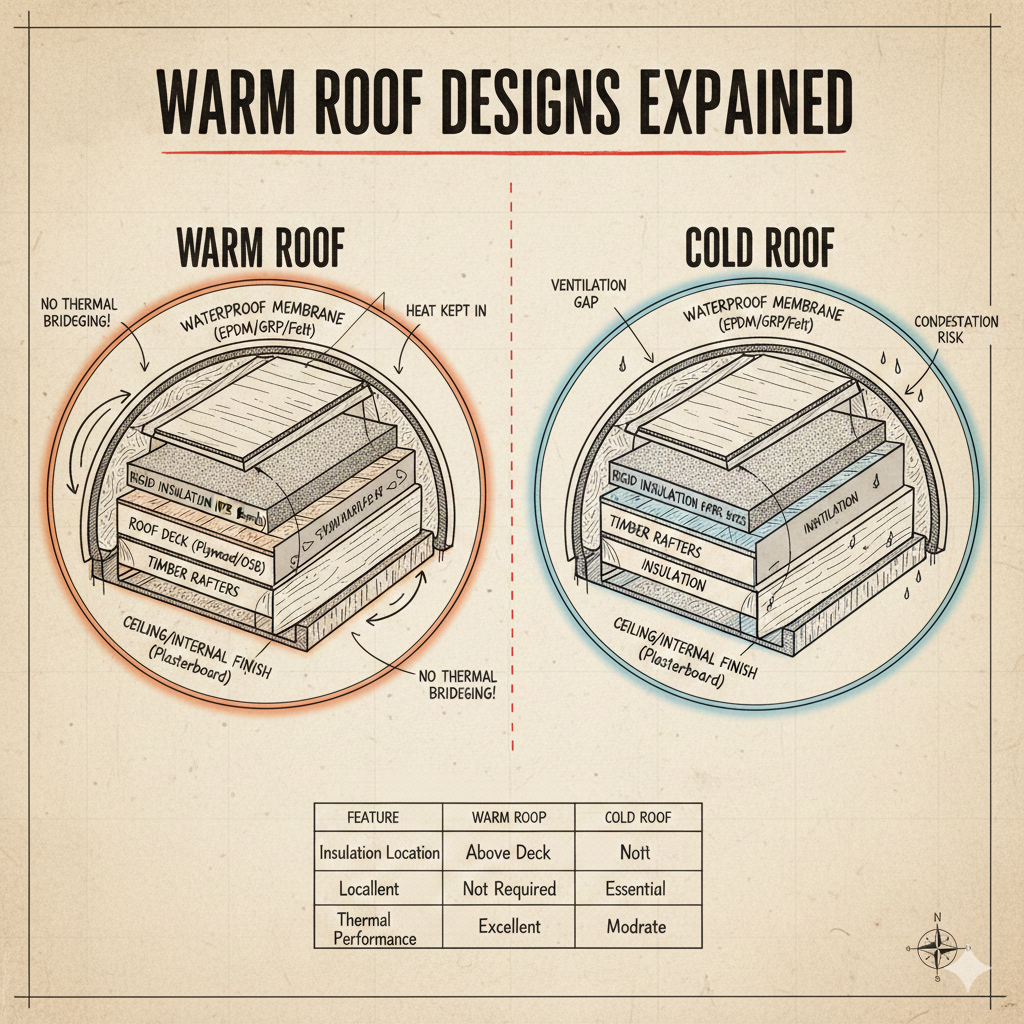
For flat roofs in the UK, warm deck designs are now the preferred option under modern guidance, including in South Wales. The typical build‑up includes a structural deck, a vapour control layer, rigid insulation boards on top, and then the waterproof membrane above everything. This approach helps flat roofs in wet areas like Pontypridd shed water effectively while still meeting tough U‑value targets, often around 0.18 W/m²K or better.
When you apply the warm roof principle to pitched roofs, the insulation follows the slope of the rafters rather than sitting at ceiling level. This keeps the roof structure within the warm zone and creates a usable, insulated loft space, which many South Wales homeowners like for storage or conversions. However, warm pitched roofs must still respect ventilation and moisture standards, including guidance in BS 5250 on controlling condensation, so the design needs careful attention to airflow and vapour movement.
Moisture control layers are essential in both flat and pitched warm roofs. A continuous vapour control layer on the warm side of the insulation helps stop moist indoor air from reaching cold surfaces, where it could condense and damage timber or plasterboard. At the same time, the outer layers must allow any trapped moisture to escape safely, so details around eaves, ridges, and penetrations are just as important as the insulation thickness itself.
If you are looking into warm flat roof regulations in South Wales, or pitched warm roof insulation options in Pontypridd, it pays to get local, project‑specific advice rather than rely on generic diagrams. U‑value targets, existing build‑ups, and practical site conditions all affect how thick your insulation must be and which materials make sense. PRBG’s roofing team in Pontypridd designs and installs warm flat roofs and warm pitched roofs that meet Welsh building regulations, keep your property comfortable, and work with real South Wales weather instead of fighting against it.
Insulation Thickness Requirements for South Wales Roofs
When you upgrade a roof in South Wales, building control will usually look at both the U‑value and the actual insulation thickness you are proposing. For most re‑roofing and renovation projects, the aim is to bring the roof as close as is reasonably practicable to current guidance, which means checking what you already have and then calculating what extra insulation is needed. Homeowners often first meet these rules when they ask, “What U‑value do I need for my roof in 2026?” or “How much insulation should I have in my pitched roof?” so it helps to see the main targets set out clearly.
Below is a simple guide to typical target U‑values and example insulation thicknesses often used as a starting point for Welsh retrofit projects. Exact thicknesses in your home can vary depending on the product you choose, how the layers are built up, and any existing insulation that stays in place. PRBG uses these benchmarks when we design roof repairs and replacements in Pontypridd, then refines the specification to match each property and its local building control requirements.
| Roof Type | Target U‑Value (W/m²K) | Example Insulation Thickness (Mineral Wool / PIR) | Welsh Retrofit Notes |
| Warm Flat Roof | 0.18 | Around 120–150mm PIR on top of the deck | Often upgraded if existing U‑value is worse than 0.35 W/m²K. |
| Cold Flat Roof | 0.18 | Around 120mm rigid insulation at ceiling level | Ventilation above the insulation is critical to avoid condensation. |
| Warm Pitched Roof | 0.13 | Around 270mm total between and over rafters | A continuous vapour control layer (VCL) on the warm side is usually required. |
| Cold Pitched Roof | 0.16 | Around 270mm loft insulation at joist level | Fire safety and access in the loft must follow Part B and related guidance. |
In many People Also Ask results, you will see questions such as “What U‑value is required for a roof in 2026?” and “How much insulation do I need in a pitched roof?” because owners want a quick rule of thumb. As a broad guide, a U‑value around 0.18 W/m²K is common for flat roofs, while pitched roofs are often pushed a bit lower, towards 0.13–0.16 W/m²K, which explains why many modern lofts and rafter spaces end up with about 270mm of insulation in total.
For retrofit roofs in Wales, building control usually accepts that you may not always reach the full new‑build standard if the existing structure or roof height limits what can be done. In those cases, the test is whether your upgrade is “technically, functionally, and economically feasible” and gets as close as practical to the target. PRBG helps Pontypridd homeowners work through this balance, so your warm flat roof, cold flat roof, warm pitched roof, or cold pitched roof gets the right insulation thickness, meets Welsh expectations, and still works in everyday use.
Insurance Rules for Flat and Pitched Roofs
When you think about roof insurance in South Wales, the shape and design of your roof can directly affect your cover and your premium. Insurers usually treat traditional pitched roofs as “standard” and look at large flat roof areas as higher risk because they are more prone to standing water, leaks, and weather damage. That means the way your flat or pitched roof is built, maintained, and documented matters when you come to renew your policy or make a claim.
For homes where more than roughly 25–30% of the overall roof area is flat, many insurers class the property as non‑standard and may push you towards specialist flat roof insurance. Once that flat roof percentage rises above this range, you often see higher premiums, stricter inspection requirements, or conditions that say the roof must be checked professionally every few years. One way to reduce this friction is to design or upgrade flat roofs with a slight pitch above about 10 degrees, where possible, so they drain better and are less likely to suffer from ponding and water ingress.
Pitched roofs with tile or slate coverings are usually easier to insure, as they fall into the standard construction category for most home insurance policies. Insurers still want to know that the roof is in good condition, meets current building regulations where it has been renewed, and uses appropriate fixings, underlay, and detailing. When you have repairs or a re‑roof carried out on a pitched roof, keeping invoices, specifications, and any completion or compliance certificates can really help your position if you need to claim after storm damage.
There is an important link between roof regulations and insurance that many guides do not explain clearly. If a major repair or replacement did not follow Part L thermal rules, local building control expectations, or basic standards for drainage and ventilation, an insurer might question the quality of the work when you claim for leaks or structural damage. Being able to show that your new roof or significant repair was done by a competent contractor and aligned with current guidance makes it much easier to demonstrate that any later damage came from an insured event, not from poor workmanship.
If you are worried about roof insurance in Pontypridd or anywhere in South Wales, it makes sense to plan repairs and upgrades with both compliance and cover in mind. PRBG, based in Pontypridd, carries out flat roof repair, pitched roof repair, and full re‑roofing with a strong focus on meeting Welsh building regulations and manufacturer installation standards. We also provide clear documentation and a 10‑year guarantee on all major repairs and new installations, which gives you extra reassurance when you talk to your insurer or need to prove that your roof has been professionally repaired.
Local South Wales Roof Regulations and Insurance
If you search online, you will not find many guides that clearly join up roof insurance and building regulations for South Wales, especially when you look for “roof insurance Pontypridd.” Most articles treat insurance and compliance as separate topics, yet in real life they are closely linked, because insurers want evidence that major roof work was carried out to current standards. When you plan a flat roof replacement, pitched roof upgrade, or large repair, it helps to think about Welsh regulations, local council expectations, and future insurance conversations at the same time rather than as an afterthought.
In Wales, roof rules sit under Welsh Building Regulations, which broadly align with the English framework but are devolved and have their own guidance. If you live in areas such as Pontypridd, Swansea, or Cardiff and you intend to re‑roof a significant part of your property, local building control normally expects to be notified before work starts, even if you are simply replacing tiles or coverings. As soon as more than around 25% of the roof is renewed, they can require you to bring the insulation closer to modern U‑value targets and to respect ventilation, fire, and structural rules.
South Wales weather puts extra pressure on both flat and pitched roofs, especially in more exposed and storm‑prone areas such as the Rhondda valleys, Bridgend, and coastal locations. Strong winds, driving rain, and repeat storm events make good ventilation, secure fixings, and robust detailing even more important, because weaknesses tend to show up quickly as leaks or damage. Fire safety and escape routes in roofs and loft spaces also need careful thought under Part B, particularly in terraced streets and converted lofts where routes and compartmentation are tighter than in detached homes.
For flat roof building regulations in South Wales, you usually need a design that handles heavy rainfall, controls condensation, and hits the right U‑value, which is why warm flat roofs with good falls and reliable membranes are so common now. Pitched roof insurance in places like Pontypridd generally stays straightforward as long as the coverings, underlay, insulation, and ventilation comply with current expectations and have been installed properly. If a major leak or storm loss occurs, being able to show that your roof met these standards can make the difference between a smooth claim and a difficult dispute.
If you are unsure how roof regulations and roof insurance line up for your home or business in Pontypridd, speaking to a local, regulation‑aware contractor can save a lot of stress later. PRBG, based in Pontypridd, provides flat roof repair, pitched roof repair, and emergency roof repair across South Wales, always with Welsh building control requirements and insurer expectations in mind. We back our major repairs and new installations with a 10‑year guarantee, so when you talk to your insurer about your roof, you can show that the work was carried out professionally, compliantly, and with long‑term performance in mind.
Why Choose PRBG for Compliant Roof Repairs in Pontypridd
When you are searching for reliable roofers in Pontypridd or typing “roof repairs near me” into Google, you need more than a quick patch job. You need a local team that understands Welsh building regulations, South Wales weather, and what insurers expect if you ever need to claim for storm or leak damage. PRBG brings all of that together, delivering repairs and replacements that are designed to last and to satisfy both building control and your home or business insurer.
Based in Pontypridd, PRBG handles all types of roof repair, including flat roof repair, roof leak repair, and conservatory roof repairs near you across South Wales. The team works on tiles, slates, felt, single‑ply membranes, and more, so whether you have a small leak above a bedroom or a failing flat roof over a shop, you get a tailored, compliant solution. Because we are local, we understand exactly how South Wales rain, wind, and storms affect roofs in Pontypridd, Cardiff, Swansea, and surrounding areas, and we factor that into every repair plan.
For added peace of mind, PRBG offers a 10‑year guarantee on all major repairs and new roof installations. This written guarantee covers parts and labour, which gives homeowners and business owners stronger reassurance when they speak to insurers or plan long‑term roof budgets. Our services include emergency roof repair for sudden leaks and storm damage, as well as commercial roof repair for shops, offices, warehouses, and industrial units across Rhondda Cynon Taf and wider South Wales.
Choosing PRBG also means your roof work is aligned with current regulations from day one. We plan repairs and replacements with Welsh building control standards, Part L energy rules, and good practice for ventilation and fire safety in mind, so you are not left worrying about compliance after the scaffolding comes down. This approach reduces the risk of future issues if you sell your property or make an insurance claim, because you can show that the roof was professionally designed and installed.
If you want to make sure your roof is safe, compliant, and ready for South Wales weather, the next step is simple. Call PRBG for a free inspection and clear written quote, and we will assess your roof, explain your options in plain language, and recommend the most sensible repair or replacement for your home or business. Whether you need urgent emergency roof repair or planned commercial roof maintenance, PRBG is ready to help you protect your property properly.